Friedrich Nietzsche birth chart and zodiac sign Saju reading
Philosopher (1844–1900) · Born 1844-10-15 (public profile · birth time unknown)
Four of the chart's six characters are earth; Fire and Water both count zero. And into that hardened ground, two Jia-wood Seven Killings stand driven like stakes — a chart with the pressure to break the self built into its foundations.
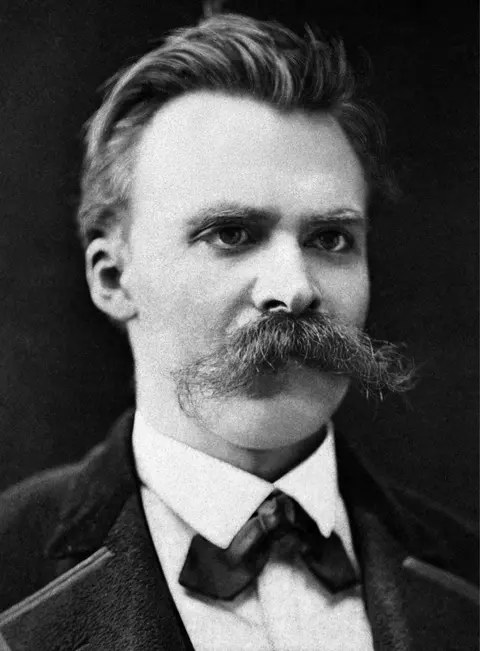 Wikimedia Commons · Public domain
The Four Pillars (Saju)
Five-Element Balance
Notable Stars (神煞)
Supreme Ultimate Noble — a foremost benefactor drawn by the heavens — a way opens where things were blocked
Red Beauty — a quiet, seeping allure — deeper and subtler than Peach Blossom
Canopy Star — a star of art and spirit that deepens in solitude — loneliness and creation paired
Hanging Needle — needle-like sharpness — precision and a pointed way with words
White Tiger — a star of intense energy — how the force is handled is what matters
White Tiger (白虎殺) — a high-pressure survival star — read only as focus and tension in public work
Branch punishment — 辰辰 self-punishment — branch pressure that asks for discipline, repetition and self-control
Sukuyo — 27 and 28 Lunar Mansions
The 27-mansion value is the natal lodge; the 28-mansion value is the lodge assigned to the calendar day. Only the calculated mansions are shown here, without adding a personality claim.
Luck Timeline (Saju)
Ten-year major cycles and annual cycles computed from the public birth date (as of 2026).
The timeline shows calculated shifts and planetary contacts; it does not fix a specific event in advance.
Birth Chart — the same person, read in Western astrology
Birth time is not public, so houses, the Ascendant, and precise Moon aspects are omitted; only non-Moon planetary positions and aspects are shown.
The Sun weighs its words in Libra while every current of the chart drains toward Mercury — a mountain range of a birth chart, studded with hammer-bearing stars.
Birth time is not public, so houses, the Ascendant, and precise Moon aspects are omitted; only non-Moon planetary positions and aspects are shown.
Saju × Astrology — the Combined Reading
Nietzsche's Four Pillars read like a geological survey.
Start with the pillars, elements and birth chart below. The prose is best read as a plain-language explanation of those repeated structures, not as a verdict.
Full interpretation
Nietzsche's Four Pillars read like a geological survey. The day master is Wu (戊), yang earth — and four of the six visible characters are earth. All three branches (Chen 辰, Xu 戌, Chen 辰) carry the peer star (比肩): his own element staring back at him from every seat. The structure is Jianlu (建禄格), a formation that stands on its own strength and borrows no one else's, compounded here by an outright excess of earth. A chart like this builds an inner world so thick that outside opinion barely registers; conviction and self become the same substance.
Into that ground, two Jia-wood (甲) stems are driven like stakes — one in the year pillar, one in the month. To a Wu-earth day master, Jia wood is the Seven Killings star (偏官): the force that strikes at the self and disciplines it into growth. Standing in the pillar of youth and the pillar of career, the order to exceed himself was posted on this chart from its earliest station to its working center. For the philosopher who made self-overcoming his life's question, the data happens to follow the biography.
What the chart lacks is just as loud. Fire and Water both count zero. Fire is warmth and outward expression; Water is fluidity and exchange. With both missing, the chart deepens endlessly inward yet never quite warms toward the outside — a structure that anticipates the solitary cast of his later working years. Even the earth itself refuses to sit still: the month branch Xu (戌) is clashed from both flanks by the two Chen (辰), a contested double Chen–Xu clash. This is not friction with the world; it is stable ground quaking against itself — the signature of a thinker who built systems and then broke them with his own hands.
The Western chart speaks with the same grain. The Sun sits in Libra, its sign of Fall, and stands in a near-exact 0.8° opposition to Pluto — a lifelong pressure to dismantle identity and build it again. Mercury, opposed by Uranus at 0.7°, turns balanced language into lightning: the very form of the aphorism, drawn as an aspect. In this birth chart, self-overcoming was never a concept he chose. It was the architecture he was given.
Structure-by-structure reading
A Wu-Chen day pillar with four earths
The day master is Wu (戊), yang earth, and around it the day and year branches (Chen 辰) and the month branch (Xu 戌) pile up until four of six characters are earth. All three branches carry the peer star (比肩) — his own element facing him from every seat. The structure is Jianlu (建禄格), one that stands on its own strength rather than leaning on anyone, and the sheer excess of earth pushes that self-reliance past sturdy into immovable. Conviction stops being something he holds and becomes what he is. Ordinary counter-arguments do not move ground like this.
Two Jia-wood Seven Killings, in the year and the month
To Wu earth, Jia wood (甲) is the Seven Killings star (偏官) — the force that strikes the self, presses it under discipline, and makes it climb over itself. He carries not one but two, standing in the year pillar, the seat of youth, and the month pillar, the seat of career. From childhood through the center of his working life, the chart kept the same order posted: exceed yourself. In the destiny chart of the philosopher of self-overcoming, two trees driven into his own ground — the data follows the life.
The month branch Xu, squeezed by two Chens
Chen (辰) and Xu (戌) clash, and here it happens twice — year against month, month against day — with the lone Xu rammed simultaneously from both flanks by the two Chens, a contested double clash. Nothing foreign intrudes: earth collides with earth, the stable ground quaking against itself, an earthquake inside the bedrock. It mirrors the way he erected systems of thought and tore them down himself almost as soon as they stood. In this chart, demolition is not damage; it is the engine of creation.
Ascetic on the surface, secretly bound underneath
The day master Wu (戊) forms a hidden combination (暗合) with the Gui water (癸) stored inside Chen (辰). Gui is his Direct Wealth (正財) — tangible reward, and affection. Outwardly indifferent, even ascetic; inwardly, quietly drawn: a double-layered structure. The Western chart says the same thing. Venus sits in Virgo, its sign of Fall, where love and the sense of beauty resist idealization and keep retreating behind criticism. Feeling ran deep in him, but rarely straight outward — it folded inward instead.
Zero Water, zero Fire
Among the five elements, Water and Fire simply do not appear. Water is exchange and fluidity; Fire is warmth and open expression. With both missing, the temperature and suppleness of relationships are structurally vacant. What remains is earth stacked thick upon earth — a terrain that deepens inward without limit but never warms toward the outside. The solitary cast of his later years is, in a sense, already posted in the natal structure.
Canopy, White Tiger, Hanging Needle — a philosopher's toolkit
The Canopy star (華蓋殺) is the star of solitude and of the artist-seeker: the talent for standing apart from the world and digging alone. The White Tiger star (白虎殺) is ferocity — the force that runs all the way to extremes. The Hanging Needle star (懸針殺) is language sharpened to a needle's point, the sentence that pierces. Add the Taiji Noble (太極貴人), which deepens a seeker's insight. Dig alone (Canopy), push to the limit (White Tiger), strike with a needle-fine sentence (Hanging Needle): the philosopher's entire toolkit is written into his stars.
A Sun in fall in Libra, opposed by Pluto
The Sun is in Libra, its sign of Fall — identity weakened precisely in the seat of harmony and other people. And that Sun stands in a 0.8° opposition to Pluto: relentless pressure to dismantle the 'I' and construct it again. A weakened self overlaid with a demolishing force leaves no stable ego to settle into; what grows instead is thought that keeps overcoming the self. The Sun is also trine Neptune (1.2°), so that identity drains toward metaphysics. This is the angle from which 'God is dead' was written.
Mercury struck by lightning
Mercury sits in Libra and meets Uranus in a near-exact 0.7° opposition. Balanced, carefully weighed language — struck by lightning. Prose that proceeds in good order and then suddenly leaps: the aphorism as a literary form, drawn as an aspect. A chart like this left few exits other than philosophy.
Jupiter and Saturn in domicile, aimed inward
Jupiter stands in Pisces, its own domicile, so the power of faith and expansion runs strong — but it is retrograde, and the force condenses inward instead of spreading out: not outward religion, but an interior metaphysics. Saturn is likewise in domicile in Aquarius — a hard, self-imposed system of discipline. Mars trine Saturn (2.8°) turned that discipline into writing sustained like an ascetic practice, while Mars opposite Jupiter (2.0°) set him head-on against the largest things available — God, morality, the age. Strong faith folded inward, iron discipline, and a frontal charge at the immense: that is the wiring.
The North Node points to Sagittarius
The growth axis of this chart runs from Gemini to Sagittarius. The South Node in Gemini is the familiar ground: fragments, quick wit, the observation that lands in one stroke. The North Node in Sagittarius names the task — binding scattered pieces of knowing into one great arc of meaning. He wrote in aphorisms, fragment by fragment, from 'Thus Spoke Zarathustra' to his genealogy of morals, yet kept driving it all toward a single philosophy. The chart's growth direction and the shape of the work coincide.
Nietzsche's birth time was never publicly recorded, so this chart is cast for local noon at Röcken, Germany, and everything that depends on the hour — the hour pillar, the Ascendant, profections, Lots — is left out. The Four Pillars are read as three pillars only. The Moon remains in Sagittarius throughout the local calendar date, so its sign does not depend on birth time. Luck cycles are described as tendencies, never verdicts, and this is offered as a retrospective reading of a man long gone — for study and enjoyment, not prophecy.
The Friedrich Nietzsche persona lives inside the Auvylo app. Built on this exact chart, its state shifts every day — and you can talk to it.
Skip the chart jargon — just ask them directly
One birthday summons your person, speaking in the voice of their own chart.
Crush · Busy boyfriend · Ex who ghosted
The real preferences you were too shy to ask — the crush
Sample chat with a summoned persona · their state shifts with the chart every day
Summon my crush — free →See it for yourself
My match with Friedrich Nietzsche, right now — free, just a birth date Open my own chart — freeA free account opens the promised chart — enter two birth dates after sign-up and continue to clashes, element balance, synastry and relationship chemistry.
 Scan to install
More charts
Yoon Seung-ah (庚申) · Son Heung-min (乙酉) · Lee Kang-in (癸丑) · Kim Min-jae (丙辰) · Hwang Hee-chan (壬戌) · Cho Gue-sung (壬申) · Hwang In-beom (庚申) · Kim Mu-yeol (乙巳)
FAQ
Even without the hour pillar, the six known characters carry the main structure — the day master, day pillar and elemental balance. Areas governed by the hour pillar (such as late-life currents) are simply not read, and this page follows that rule.
No. It is a records-based reading from the publicly known birth date only, unrelated to the person's actual character or private life, and meant for entertainment. Saju never defines a person.
ⓘ Based on the publicly known birth date · birth time unknown (hour pillar, ascendant and houses omitted) · AI / classical readings are reference, not verdicts. This page is unaffiliated with the person and will be removed on request ([email protected]).